AI PDF Summarizer: Instantly Summarize Documents

I still remember the exact moment I broke. It was March 2024. I had 63 PDFs stacked on my desk: 41 research papers, 12 client reports, 7 contracts, and 3 industry whitepapers, all due for review within a week. My eyes were burning, I was on my third coffee, and I realized I was spending 80% of my time just finding the important parts instead of actually understanding them.
That’s when I started relying heavily on AI PDF summarizers. Not as a replacement for reading, but as a high-powered research assistant that could cut through the noise instantly.
After using them daily for over 18 months across academic work, consulting projects, legal reviews, and personal research, I’ve developed a very clear picture of what these tools do well, where they fall short, and how to use them responsibly.
Why AI PDF Summarizers Have Become Essential
We’re drowning in information. A single research report today is often 40–120 pages. Contracts can easily hit 80 pages. Earnings reports, clinical trials, and government policies are all getting longer while our time is shrinking.
An effective AI PDF summarizer solves the biggest bottleneck: finding the signal in the noise. It can extract key points, main arguments, conclusions, methodology, risks, and action items in minutes instead of hours.
Best Real-World Use Cases
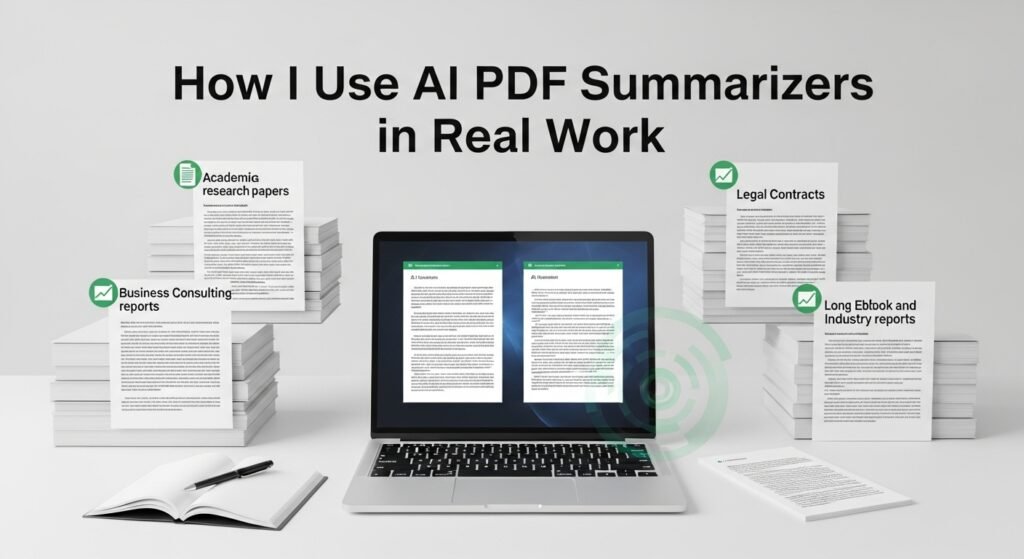
1. Academic & Thesis Research
This is where I use them most. I upload 10–15 papers at once, and the summarizer gives me a clean breakdown of purpose, methodology, findings, and limitations for each. Last year, while writing my thesis on climate finance, this approach helped me process 128 papers in 11 days instead of the usual 6–7 weeks.
2. Business & Consulting Reports
For client deliverables, I use it to quickly grasp quarterly reports, market analyses, or due diligence documents. It’s excellent at pulling out financial highlights, risks, and strategic recommendations.
3. Legal & Contract Review
It’s surprisingly good at flagging key clauses, termination conditions, payment terms, liability limits, and change-of-control provisions. I still read the full contract afterward, but the summarizer tells me exactly where to focus my attention.
4. Long Ebooks & Industry Reports
I read a lot of 200–400 page reports for work. The summarizer gives me chapter-by-chapter key takeaways so I can decide which sections deserve a full read.
How Good Are They Really? (Honest Results)
Strengths:
- Outstanding at extractive summaries
- Excellent at creating structured outputs
- Very fast, a 90-page PDF in under 40 seconds
- Good at handling technical content
Weaknesses I’ve Observed:
- They sometimes miss nuance or subtle caveats, especially in academic papers
- Can occasionally hallucinate minor details or overstate conclusions
- Struggle with highly technical equations or complex data tables
- Can flatten author tone, a passionate argument becomes neutral corporate speak
My Personal Workflow (What Actually Works)
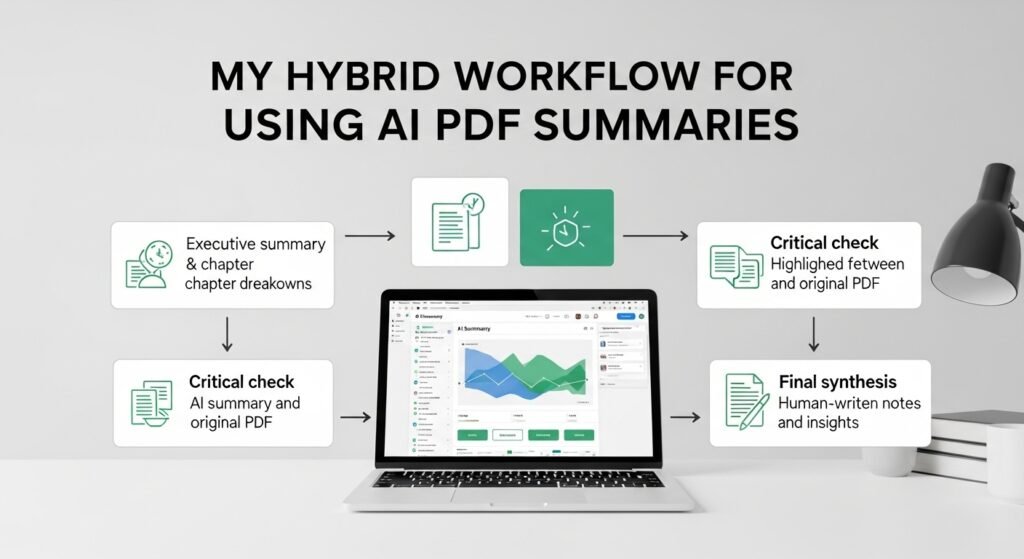
I never blindly trust a summary. Here’s the exact process I follow:
- First pass → Generate a one-page executive summary + chapter breakdowns
- Second pass → Ask for key quotes and limitations/risks sections
- Critical check → Manually verify the top 3–5 most important claims against the original PDF
- Final synthesis → Write my own notes combining the summary with my insights
This hybrid method gives me 85–90% of the value with only 15–20% of the reading time.
Ethical Considerations & Red Flags
In academic settings, using these tools is a gray area. Many universities now require disclosure if AI summarization was used. I always cite my sources properly and never submit a summary as my own analysis.
For business and legal work, confidentiality is paramount. I only use enterprise-grade tools that don’t train on uploaded documents.
When You Should Still Read the Full Document
- Highly technical or controversial papers
- Legal contracts or financial agreements
- Anything where you are the final decision-maker
- When the stakes are high, funding proposals, regulatory filings, and medical literature
An AI PDF summarizer is an incredible time multiplier, but it’s not a replacement for critical thinking.
FAQs
1. Are AI PDF summarizers accurate enough for serious work?
They’re about 85–92% reliable for most documents. Good enough for initial screening and research triage, but not for final decisions without verification.
2. Can they handle scanned PDFs or poor-quality documents?
Most modern tools handle OCR well now, but very old or low-resolution scans can still cause errors.
3. Do they work with very large files (200+ pages)?
Yes, the best ones handle 300–500 page documents without issues in 2025.
4. Is it safe to upload confidential documents?
Only use tools with strong privacy policies. Never upload sensitive client or legal files to free tiers.
5. Will professors or clients know I used one?
If you copy-paste the summary directly, yes, the writing style is often recognizable. Always rewrite in your own words.

Post Comment