AI Tools for Marketing and Promotion

Let’s be honest: the term “AI marketing” has been buzzed about so much that it’s starting to lose meaning. It’s either painted as a robotic overlord coming for our jobs or a magical make me viral button. Having spent the last few years in the trenches, integrating these tools into real campaigns for actual businesses, I can tell you the truth is far more nuanced and far more useful. AI isn’t replacing marketers; it’s reshaping our toolkit, automating the grind, and amplifying our creativity, but only if we know where to point it.
Think of it like this. Ten years ago, a marketer’s day was a scramble: manual ad bidding, gut-feel audience guesses, and the dreaded blank page for content. Today, it’s less about starting from zero and more about steering a powerful engine. The real shift isn’t in the what of marketing, the goals are still awareness, conversion, loyalty, but in the how.
From Brainstorming to Bedrock: The Practical Playbook
1. The Content Co-Pilot:
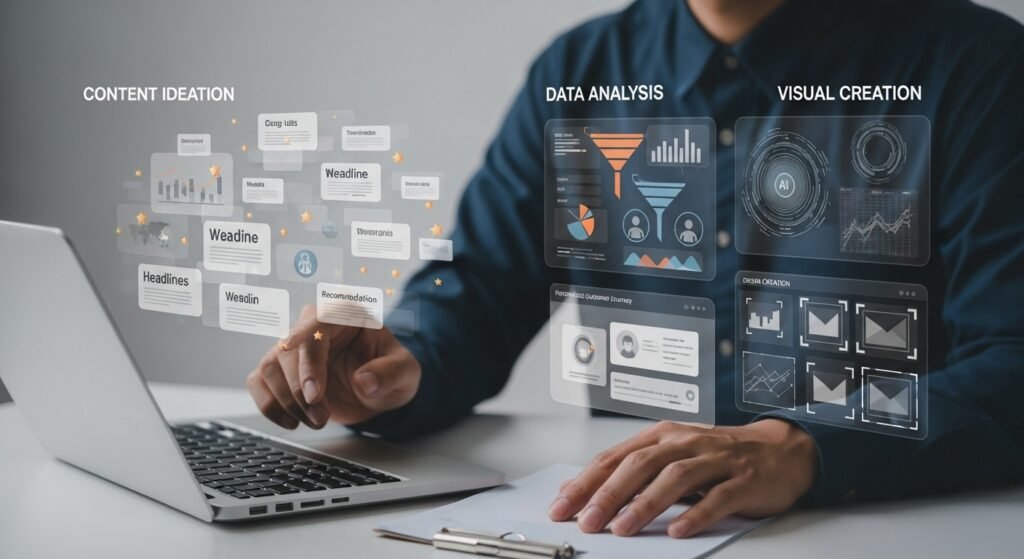
The blank page is the enemy of momentum. Tools like Jasper or Copy.ai act as phenomenal brainstorming partners. I don’t use them to write the final product. Instead, I feed them a raw idea value proposition for a sustainable coffee subscription targeting millennials and generate ten headline variants, five email hooks, or a list of key pain points. It breaks the initial inertia. The catch? The output is often generic. Your job as a human is to inject brand voice, nuance, and that spark of real insight. I recently used this method for a client’s blog pillar page; AI outlined the structure and suggested sub-topics based on SEO data, which saved hours of research, allowing me to focus on crafting the deep, interview-driven narratives that became the article’s core.
2. The Data Decoder:
This is where AI moves from handy to indispensable. Platforms like HubSpot’s AI features or Google Analytics’ insights can now look at your customer journey and tell you things you’d miss. It might spot that users from a specific ad set are dropping off not at checkout, but at the shipping info page, and correlate that with a slight price jump for their region. Previously, finding that needle in the haystack took days of slicing data. Now, it’s a flagged alert. The ethical consideration here is crucial: you must audit these insights for bias. Is the AI suggesting you only target a certain demographic because that’s who your past (potentially narrow) campaigns reached? You have to ask the “why” behind the algorithm’s what.
3. Hyper-Personalization at Scale:
Remember when personalization meant putting a first name in an email? AI-powered platforms like Klaviyo or Dynamic Yield can now tailor entire experiences. Based on browsing behavior, past purchases, and even engagement time, you can dynamically populate website banners, adjust product recommendations in real-time, and segment email flows with incredible granularity. A case study from a small e-commerce client: by implementing an AI-driven abandoned cart sequence that offered personalized product pairings, not just a reminder, they recovered 28% more lost sales. The tool executed the logic; we provided the creative messaging and brand-safe pairing rules.
4. The Visual Accelerator:
Canva’s AI tools, Midjourney, and DALL-E 2/3 have sparked a creative revolution. Need a specific mood board image for a social post? Need fifty variations of a product mockup for A/B testing? AI can generate them in minutes. For small teams without a full-time designer, this is a game-changer. However, the limitation is brand consistency. AI is terrible at maintaining exact logo colors, typography, and the intangible feel of your visual identity. My rule is to use it for ideation, inspiration, and generating base assets, which are then refined and locked into our brand guidelines by a human eye.
The Human Imperative: Strategy, Ethics, and Taste

This is the non-negotiable part. AI is a computation engine; it has no strategy, no ethics, and no taste.
- Strategy is Yours: An AI can optimize a Facebook ad for the lowest cost-per-click. It cannot decide if your Q4 goal should be brand awareness or direct sales. You set the destination; AI helps plot a more efficient course.
- Ethics Are Your Guardrails: AI Trained on Public Data Can Reflect Societal Biases. It’s on you to ensure your automated messaging is inclusive and fair. Always have human oversight on targeting parameters and content.
- Taste is Your Differentiator: AI can compose a technically correct social post. It cannot replicate the witty, timely, culturally-aware tone that makes a brand feel human. That’s your superpower.
The Bottom Line
We’re past the hype. AI tools for marketing are now just tools. Extraordinarily powerful ones that handle the computational heavy lifting, data analysis, multivariate testing, content scaffolding, and repetitive task automation. This frees us, the marketers, to do what we do best: understand the deeper human needs, build authentic brand stories, make strategic judgment calls, and forge real connections.
The future belongs not to the marketer who fears the algorithm, but to the one who learns to be its conductor.
FAQs
Q: Aren’t AI-written emails and posts obvious and robotic?
A: They can be, if used as a final draft. Use AI output as a first draft or idea generator, then heavily edit it to add your unique voice, anecdotes, and brand personality.
Q: Is AI marketing only for big companies with big budgets?
A: Absolutely not. Many powerful AI tools are integrated into affordable platforms like Canva, Grammarly, or email marketing services or offer freemium tiers, making them accessible to solopreneurs and small businesses.
Q: Will AI replace marketing jobs?
A: It will replace certain repetitive tasks, not strategic roles. The demand will shift towards marketers who can leverage AI tools strategically, interpret their outputs, and apply creative and ethical human judgment.
Q: How do I get started without being overwhelmed?
A: Pick one pain point. Is it writing weekly blog ideas? Try a content ideation tool. Is it analyzing your campaign data? Dive into your platform’s built-in insights. Master one tool in one context before expanding.
Q: Are there ethical concerns with AI in marketing?
A: Yes. Key concerns include data privacy, algorithmic bias in targeting, and transparency. Always be clear about how you use customer data and ensure your AI-assisted messaging is inclusive and representative.



Post Comment