Top AI Tools for Small Business Growth in 2026
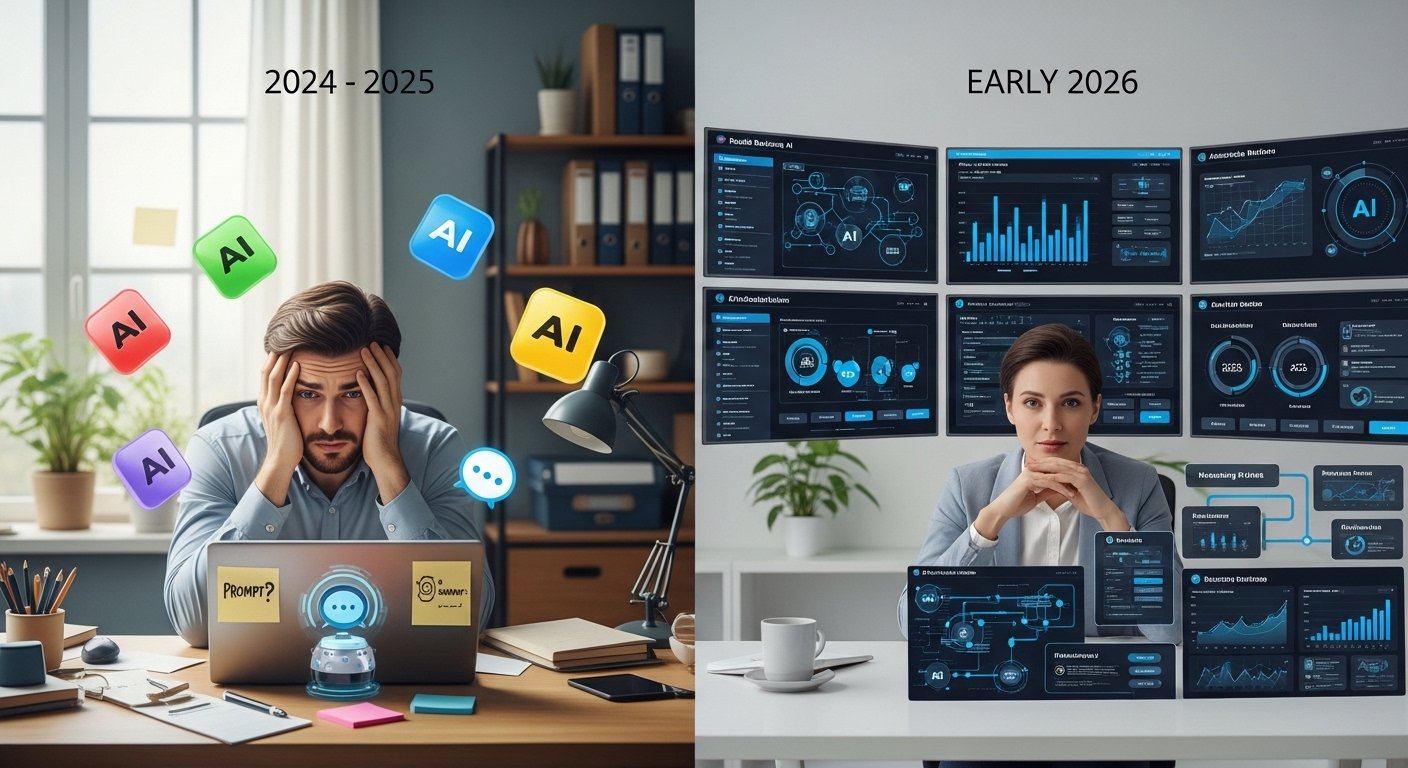
I still remember the “AI Gold Rush” of 2024 and 2025. Back then, every small business owner I consulted with was scrambling to figure out what a “prompt” was, treating chatbots like novelty toys. Fast forward to today, early 2026, and the conversation has completely changed. We aren’t talking about chatting with AI anymore; we are talking about employing it. If you’re running a small business right now, you know the economy has tightened. We’re operating with leaner teams, yet the customer expectation for speed has never been higher.
The tools that defined the early AI era have matured from experimental gadgets into robust infrastructure. In my work helping agencies and local businesses streamline operations this year, I’ve seen a clear divide. The businesses that are growing are the ones moving from “AI generation” to “AI orchestration”.Here is a look at the tools that are actually moving the needle for small businesses in 2026, stripped of the hype and focused on ROI.
1. The “Brain” of Operations: ChatGPT/Claude Projects
It feels almost redundant to mention OpenAI or Anthropic, but their utility has shifted drastically in the last 18 months. In 2026, we aren’t using these tools just to write emails. We are using them as reasoning engines. With the latest iterations of Claude Projects and ChatGPT’s persistent memory, I’m seeing business owners build specific personas that stay consistent for months. For example, one client of mine, a boutique logistics firm, uses a dedicated Claude Project loaded with every invoice, shipping manifest, and email from the last two years. They don’t ask questions; they actively monitor discrepancies in real-time.
Why it wins in 2026: Context windows are now massive. You can dump your entire business strategy, brand voice guidelines, and quarterly data into these models, and they retain it. It’s less like a tool and more like a Chief of Staff that never sleeps.
2. The Video First-Mover: Runway & Sora Integration
Text is still important for SEO, but in 2026, if you aren’t doing video, you’re invisible on social. The barrier to entry used to be high cameras, lighting, and editing. Tools like Runway, specifically their latest Gen-series updates and the wider integration of Sora capability into creative suites, have democratized high-end production. I recently worked with a local real estate agency that couldn’t afford drone shots.
Using text-to-video generation, we created realistic neighborhood flyovers that were indistinguishable from the real thing to the average viewer. This isn’t just about fake video; it’s about B-roll. Small businesses can now generate high-quality background assets for their marketing without paying for stock footage subscriptions or organizing shoot days.
3. The Sales Hunter: Clay & Apollo.io
If you are in B2B, the old way of prospecting, manually searching LinkedIn, guessing emails, is dead. Clay has emerged as the darling of the 2026 sales stack. It’s essentially a spreadsheet on steroids that uses multiple AI agents to scrape the web, enrich data, and write hyper-personalized outreach. Here is a real-life use case: I set up a workflow for a design agency where Clay scans LinkedIn for VP of Marketing roles at companies that just raised funding using Crunchbase data.
It then visits their company website, reads their latest blog post to understand their current focus, and drafts an email referencing that specific post. A human just has to click approve. It does the work of three SDRs, Sales Development Representatives, for a fraction of the cost.
4. The Customer Service Agent: Intercom Fin & Synthflow
Voice AI has finally crossed the uncanny valley. In 2024, AI voice agents sounded robotic and annoying. Today, tools like Synthflow or Bland AI are handling appointment setting for dentists and HVAC companies with shocking fluidity. They can handle interruptions, pauses, and accents. On the chat side, Intercom’s Fin has evolved. It’s no longer just deflecting tickets; it’s solving them. It connects to your backend, like Shopify or Stripe, to process refunds or check order statuses without a human ever logging in.
Ethical Note: I always advise my clients to be transparent. Your bot should identify itself as an AI. Trust is the currency of 2026; don’t burn it by trying to trick your customers.
5. The “Boring” Backend: Microsoft Copilot 365
It’s not flashy, but Microsoft Copilot integrated into Excel, Word, and Teams is where the real productivity gains are happening for traditional businesses. The ability to attend a Teams meeting, have Copilot transcribe it, summarize action items, and immediately draft follow-up emails in Outlook is a workflow that saves my clients about 5 to 10 hours a week per employee. For a small business of 10 people, that’s essentially gaining a free employee. The integration is seamless now compared to the clunky rollout a few years ago.
The “Agentic” Shift and Cautionary Advice

The theme for 2026 is Agency. We are moving away from Chatbots asking for info to Agents asking for action. However, a word of caution from someone who has cleaned up many messy AI implementations: Automation amplifies incompetence. If your underlying business process is broken, AI will just break it faster and at scale.
Before you subscribe to any of these tools, map your workflow on a whiteboard. Identify exactly where the friction is. Do not implement AI just to say you have it. I’ve seen businesses automate their customer support so aggressively that they insulated themselves from feedback, only realizing six months later that their product had a major flaw that the AI was politely handling without reporting.
Final Thoughts: The Human Premium
Ironically, as these tools become ubiquitous, human work becomes a luxury product. If you run a small business, use AI to handle the logistics, the data entry, and the initial drafting. But use the time you save to pick up the phone. Meet clients for coffee. Handwrite a thank-you note.In 2026, everyone has a Super Brain AI assistant. The competitive advantage isn’t who has the best AI anymore; it’s who has the best humanity, supported by AI efficiency.
FAQs
Q: Is it worth paying for the Enterprise versions of ChatGPT or Claude for a small team?
A: In 2026, yes. The data privacy guarantees alone are worth it. You do not want your proprietary business data training the public models. Plus, the “Projects” or “Team” workspaces allow for shared knowledge bases, which are critical for consistency.
Q: Will these AI video tools replace my videographer?
A: Not for everything. They replace stock footage and basic B-roll. They do not replace the emotional connection of a founder telling their story to the camera or genuine testimonials. Use AI to augment your content, not to fake your identity.
Q: How do I avoid “AI fatigue” with my customers?
A: Don’t use AI to write your final copy. Use it to brainstorm and structure, but rewrite the final output yourself. People in 2026 have a very calibrated radar for “AI voice” words like delve, tapestry, and elevate are dead giveaways. Keep it raw and conversational.
Q: Are voice AI agents actually good enough for phone calls now?
A: They are for specific tasks like confirming appointments, qualifying leads, or answering FAQs. They are not ready for high-stakes negotiation or complex emotional support. Use them to filter simple calls so you can focus on the high-value ones.
Q: What is the biggest mistake small businesses make with AI in 2026?
A: Trying to automate everything at once. Pick one bottleneck, like invoice processing or social media scheduling, solve that, and then move to the next. Over-automation leads to a sterile brand that feels like a ghost town.



Post Comment